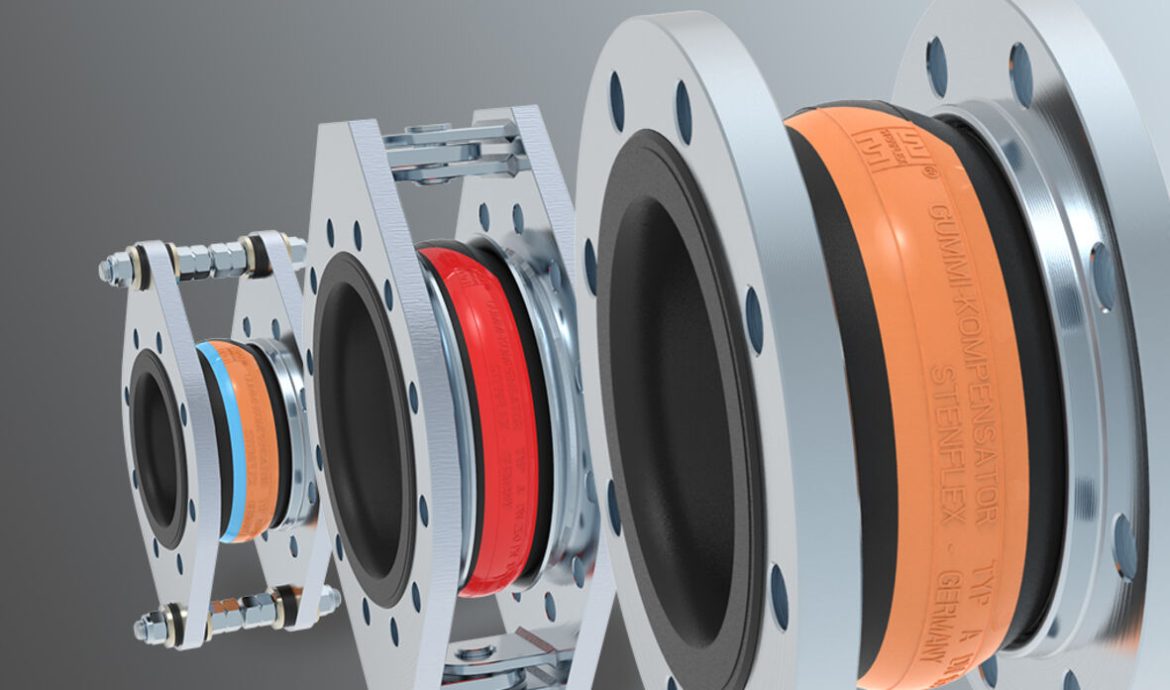
Your search to select the types of non-metallic expansion joints ends here. Gone are the days of using metallic expansion joints with the invention of many polymers. It is because of the many advantages of using ducting non–metallic expansion joints over metal joints. Also, you have various choices, from the many rubber expansion joints to choosing the right one per your need and budget. Additionally, they are more flexible to be ideal for bridges and many industries like petroleum, oil & gas, and others.
So, check out the many advantages of selecting the correct type of non-metallic expansion joints for better safety, durability, and affordability.
What are NMEJs or non-metallic expansion joints?
From their first patent in 1920, expanding joints have protected many infrastructural and heavy industrial needs for over a century. Though the early expansion joint was made of metal, the rubber expansion joints became famous for their additional flexibility and other advantages. Made of natural rubber or synthetic elastomers is the first choice for most industrial and energy plants. Also known as NMEJs or non-metallic expansion joints, they have become the essential components for use as flexible connectors. Embedded with unique fabrics for providing physical reinforcement, they are ideal for many applications.
Ducting non-metallic expansion joints designed for providing stress relief in ducting systems are flexible connectors to absorb moments caused by thermal changes. They act as shock absorbers and vibration isolators and are used for minor misalignment for adjoining ducting or equipment. These expansion joints are ideal for ducts with pressure less than 3 psi or 2000 mm w/c and temperatures up to 1000 degrees centigrade. Fabric or rubber expansion joints act as connectors between vessels or systems that transport fluids, gases or slurries under pressure at various temperatures. Also, they get installed in gas and air duct systems in power plants, diesel engine installations, gas turbine systems, cement & steel works, cement plants, petrochemicals, incinerators, ships & cruise vessels and others.
What are the essential flexible rubber expansion joints?
Flexible rubber expansion joints made of various superior synthetic rubber materials are available in many standard sizes and customized per the client’s specific needs. Unlike metallic joints, rubber expansion joints for pipes do not crack or drop temperature and pressure. Also, they are easy to install, require less maintenance, and can withstand more significant movements than metallic joints. The best ducting non-metallic expansion joints manufacturer offers a wide range of joints using the latest technology to have high quality to handle high temperatures and pressure. A few of the significant flexible rubber expansion types include.
- Arch rubber expansion type is available as single and multiple with full-face integral flange design made from thick elastomers molded into the arch shape to withstand movement over long lengths.
- PTFE rubber expansion joints with fibroblastic liners of FEP or TFE provide resistance for all exposed surfaces against all chemicals.
- Sleeved arch-type rubber expansion joints for pipes slide on the straight ends to be secure with clamps with significant application to lower the medium pressure and vacuum systems.
- Reinforced rubber expansion joint offers pressure resistance caused by extended flange rings, which are part of it to compensate for ring reinforcement or lack of internal wire within the carcass.
How do select the correct type of non-metallic expansion joints?
With so many non-metallic rubber expansion joints available, you need to know how to select the best among them per the requirement and budget. There are many factors to consider for it that include.
- The thermal movement inside the duct system, design values of the medium pressure and temperature
- The nature and composition of the medium flowing inside the ductwork, gas velocity, space availability, and special requirements for installation
- The temperature changes, sleeve arrangement or the mechanical protection against abrasion, elastomer or polymer quality, and others
The above facts, types, and factors will help you to select the suitable non-metallic rubber expansion joints for the best performance.